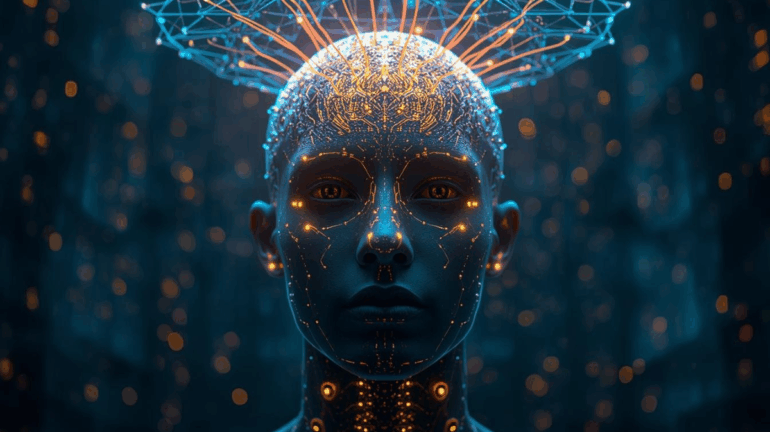

For centuries, humanity has dreamed of fusing mind and machine a world where thought itself could control technology. Today, that dream is rapidly becoming reality through the rise of neural interfaces, devices that connect the human brain directly to computers. What once seemed like science fiction is now being tested in laboratories and even implanted in humans. Companies such as Neuralink, Synchron, and Kernel are at the forefront of this frontier, using artificial intelligence to decode the complex language of the brain. Neural interfaces, also called brain-computer interfaces (BCIs), work by detecting electrical signals produced by neurons and translating them into commands that machines can understand. These systems have already enabled paralyzed individuals to move robotic arms or type messages using only their thoughts a breathtaking demonstration of how AI can bridge biology and technology. But beyond restoring movement or speech, this technology holds the promise of enhancing human cognition, learning, and creativity. Imagine instantly downloading knowledge, communicating ideas through thought, or controlling digital devices without speaking or typing. The combination of AI and neuroscience could give rise to a new era of human capability one where the boundaries between physical and digital consciousness blur.
The power behind these breakthroughs lies in AI’s ability to process vast and noisy streams of neural data. The human brain contains nearly 86 billion neurons, each firing thousands of times per second. Interpreting that torrent of information requires machine learning models capable of recognizing subtle patterns, translating brain signals into meaningful outputs, and adapting over time to each user’s unique neural signature. Over the next decade, AI could make it possible for neural interfaces to achieve two-way communication not just reading the brain, but writing back to it. In this future, humans and machines would form a closed cognitive loop, where AI augments memory, accelerates decision-making, and even enhances emotional regulation. Students might learn new skills in days rather than months, and people with neurological conditions like Alzheimer’s could regain lost functions through digital reinforcement.
Yet, the integration of AI with the human brain raises profound ethical, philosophical, and social questions. What happens when our thoughts are no longer entirely private? Could governments or corporations exploit neural data for surveillance or profit? The concept of “mind hacking” once fictional becomes a real concern when brain activity can be recorded, stored, and analyzed. Moreover, the possibility of cognitive enhancement introduces new inequalities: will neural augmentation become a privilege for the wealthy, deepening the gap between those with enhanced minds and those without? Privacy, autonomy, and even identity itself must be redefined in this new landscape. If thoughts can be translated into data, where does “self” truly begin and end?
Despite these challenges, the benefits are equally transformative. Neural interfaces could help millions suffering from paralysis, depression, epilepsy, and other neurological disorders. They could allow amputees to feel sensations in prosthetic limbs or give voice to those who cannot speak. They could even serve as tools for empathy enabling people to share emotions or memories directly, breaking down barriers of communication that language cannot bridge. As AI continues to evolve, the vision of a “symbiotic intelligence” a partnership between biological and artificial minds grows closer. It will not replace humanity but rather expand it, allowing humans to evolve intellectually in ways once thought impossible. The future of neural-AI fusion will challenge our definitions of thought, emotion, and consciousness itself. But as long as humanity approaches it with ethics, empathy, and care, this fusion may mark the next great leap in human evolution the dawn of the truly connected mind.
Contributed by Guestposts.Biz