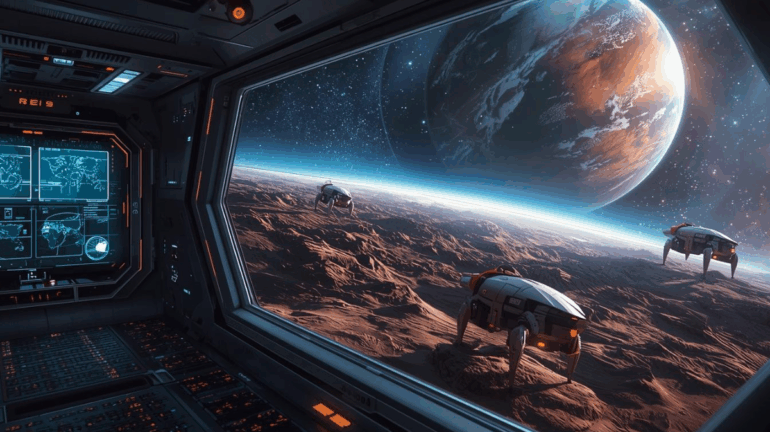

Artificial intelligence is rapidly becoming one of the most important tools in humanity’s pursuit of the cosmos. As space agencies and private aerospace companies push further into deep space, our ability to explore, map, and interpret the universe increasingly relies on intelligent systems that can process complex data, identify patterns, and make autonomous decisions. AI has shifted from being a supportive technology to a critical force multiplier one that allows scientists to explore regions humans cannot reach, decode signals the human mind is too slow to analyze, and operate missions too dangerous or expensive for crewed travel. In this new era, AI isn’t just helping us explore space; it’s expanding our understanding of what exploration even means.
One of the most transformative applications of AI is in spacecraft navigation. Deep-space environments involve communication delays that make real-time human control impossible. When a signal takes minutes or even hours to reach its destination, the spacecraft needs to think for itself. NASA’s Mars rovers Spirit, Opportunity, Curiosity, Perseverance are already early examples of this. They can decide how to avoid obstacles or choose the safest path without waiting for instructions from Earth. This autonomy is now being taken to entirely new levels with AI-driven guidance systems that can process sensor data instantaneously and make predictive decisions, enabling spacecraft to adjust trajectories, avoid hazards, and optimize maneuvers in environments where a single mistake could end a mission.
AI also plays a major role in analyzing astronomical data, an area where the scale of information far exceeds human capacity. Telescopes and satellites generate terabytes of data daily from images of distant galaxies to readings on cosmic radiation. Machine learning models can sift through this data at speeds impossible for human researchers, detecting anomalies, identifying star patterns, discovering new planets, and even predicting celestial events. The discovery of exoplanets has advanced exponentially thanks to AI systems capable of analyzing light curves from telescopes like Kepler and TESS. What used to take human astronomers months or years can now be done in minutes.
Another frontier for AI is the exploration of hostile environments such as asteroids, the Moon’s dark craters, and even icy moons like Europa or Enceladus, where scientists suspect life may exist beneath frozen surfaces. Traditional robots are limited by pre-programmed routines, but AI-powered robotics can adapt to unpredictable terrain, learn from sensor feedback, and navigate environments that have never been mapped. Future missions involving subterranean lava tubes on the Moon or liquid oceans below icy shells will require robots that can think, respond, and survive independently a capability only possible through advanced AI.
Beyond exploration, AI is accelerating space engineering and mission design. Simulations powered by machine learning can model spacecraft performance, forecast system failures, and optimize fuel consumption. AI can even propose new spacecraft designs by running through millions of variations, predicting structural stress, and identifying the most resilient materials. Space agencies are increasingly relying on generative design tools AI systems that create components with geometries no human engineer would imagine but that are lighter, stronger, and more efficient for space travel.
AI is also essential in maintaining long-term human presence in space. As missions to the Moon and Mars become more realistic, astronauts will rely on intelligent systems to monitor their health, manage life support, and maintain habitat systems. AI can detect anomalies in oxygen levels, radiation exposure, and psychological patterns before they become critical. It can also handle routine tasks like repairs or resource allocation allowing astronauts to focus on scientific work. In deep-space missions, where communication with Earth may be limited, AI-driven medical assistants and autonomous diagnostic tools will become essential for crew safety.
Looking ahead, the integration of AI into space exploration will likely redefine the boundaries of human knowledge. Future AI systems could run entire missions from selecting landing sites to drilling for samples, analyzing extraterrestrial soil, identifying signs of life, and sending the results back to Earth. As quantum computing merges with AI, space exploration may enter an era where intelligent algorithms process cosmic data at unimaginable speeds, uncovering hidden structures of the universe and answering questions that have puzzled scientists for centuries.
Ultimately, AI is not replacing human explorers it’s amplifying human capability. It gives us the power to traverse vast distances, decode cosmic mysteries, and operate where the human body cannot survive. As AI becomes smarter, faster, and more autonomous, our ability to explore the universe will evolve in ways that were once possible only in science fiction. From navigating distant worlds to uncovering the origins of galaxies, intelligent machines are becoming indispensable partners in humanity’s greatest adventure: understanding the cosmos.
Contributed by Guestposts.Biz