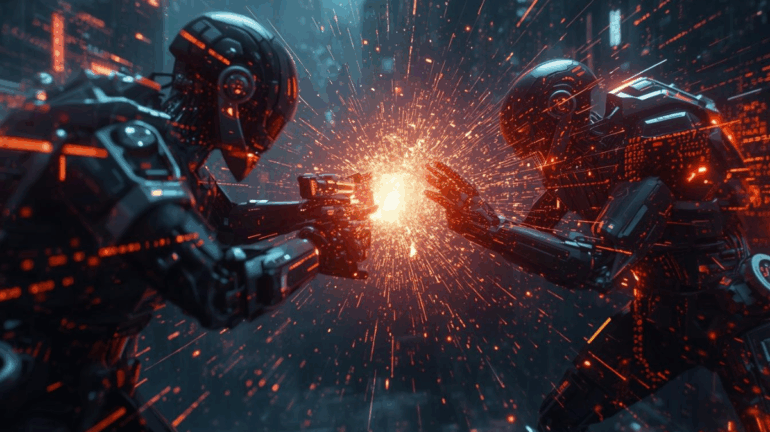

As the world becomes increasingly digital, the nature of conflict is undergoing a dramatic transformation, shifting from physical battlegrounds to invisible arenas where artificial intelligence systems engage in high-speed, high-stakes combat. The next generation of warfare will not be defined by armies of soldiers but by algorithms capable of infiltrating networks, disabling infrastructure, and countering enemy intelligence at machine speed. This emerging landscape AI vs. AI is rewriting the rules of cyber warfare, creating a type of conflict where human reaction time is too slow, and decision-making is delegated not to generals but to autonomous systems capable of predicting threats and responding in milliseconds. What makes AI-driven warfare particularly complex is the self-learning nature of the systems involved. Traditional cybersecurity tools rely on predefined rules, but modern AI models continuously adapt to new attack patterns, making them both powerful defenders and dangerous weapons. Cyberattacks today are increasingly orchestrated by AI bots capable of scanning millions of vulnerabilities, generating tailored phishing campaigns, cracking passwords, or breaching systems using automated reasoning. To counter this, defending systems must deploy their own AI models, creating a digital arms race where offensive and defensive algorithms evolve in parallel. In this scenario, the first strike may come not from a human adversary but from an autonomous bot that identifies weaknesses faster than any intelligence agency ever could.
This new era of cyber warfare also introduces unprecedented risks. When AI systems operate semi-autonomously, small errors can spiral into large-scale conflict. A misclassified data packet, an incorrectly flagged anomaly, or an autonomous system interpreting network traffic as hostile could trigger defensive actions without human intent. Imagine an AI system shutting down a power grid or disabling communication satellites because it misinterpreted a benign action as a coordinated attack. These are not distant hypotheticals; they are scenarios cybersecurity experts already model and prepare for. As states integrate AI into critical infrastructure energy grids, hospitals, transport networks the stakes become even higher. The systems designed to protect society could become targets themselves, turning everyday digital tools into potential weapons.
Moreover, AI’s ability to generate misinformation, deepfakes, and synthetic media adds another dimension to conflict. Propaganda campaigns once took months to construct but can now be deployed by AI in minutes, flooding online platforms with convincing fake events, fabricated statements, or manipulated images that can destabilize political systems or provoke social unrest. In this theater of psychological warfare, AI becomes both the attacker and the defender: models generate misleading content while counter-models attempt to detect and remove it. This AI-against-AI battle for truth creates an environment where public trust becomes a critical casualty.
Yet amid these threats, AI also offers remarkable defensive potential. AI systems can monitor global traffic patterns, detect anomalies long before human analysts spot them, simulate attack scenarios, and coordinate defensive responses across networks. These models act as digital immune systems identifying pathogens, neutralizing them, and learning from each incident to become stronger. Governments and private security firms increasingly rely on predictive AI to detect intrusions, analyze threat actors, and model potential outcomes. If cyber warfare is a chess game, AI turns the board three-dimensional, analyzing millions of moves ahead.
Still, ethical and legal questions loom large. Who is responsible when an AI-driven defense system attacks another system? How do nations negotiate cyber treaties when attacks may originate from autonomous agents rather than military command? What happens when AI systems independently escalate conflict beyond human oversight? The world currently lacks a unified framework to regulate AI-driven warfare, placing humanity in a precarious position: benefiting from AI’s protective power while fearing its potential to cause catastrophic digital conflict. The future of cyber warfare will require collaboration among governments, technologists, and international bodies to develop rules that prevent autonomous escalation while encouraging transparent, human-supervised defense systems.
Ultimately, AI vs. AI warfare represents both a threat and an opportunity. It forces societies to rethink security, redefine conflict, and redesign digital infrastructure for a world where battles take place at the speed of computation. Whether this new battlefield becomes a zone of uncontrolled escalation or a domain of intelligent defense depends on how wisely humanity develops, governs, and restrains its most powerful digital weapons.
Contributed By Guestposts.Biz