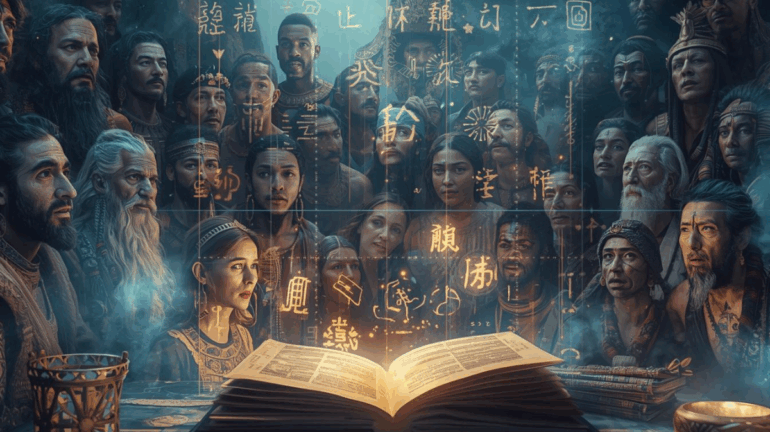

Around the world, thousands of languages and cultural traditions are disappearing at an alarming rate. Globalization, migration, and modernization are pushing smaller cultures toward extinction, and many could vanish within a generation. Yet, at a moment when human diversity faces unprecedented threats, artificial intelligence is emerging as an unexpected savior. Through advanced language models, machine learning, and cultural analytics, AI is beginning to revive, restore, and preserve endangered languages, rituals, stories, and heritage in ways no previous technology has achieved. What once required decades of anthropological fieldwork can now be accelerated through AI-powered pattern recognition, translation systems, and archival reconstruction, sparking what many call a new “AI Renaissance” for human culture.
AI’s impact begins with language, the core of cultural identity. Thousands of languages have limited written records or are spoken by only a few elders. AI can analyze scattered audio recordings, transcribe rare dialects, reconstruct grammar structures, and even generate learning tools for communities seeking to revitalize their native tongue. Neural networks can identify patterns in speech that humans miss, enabling the revival of languages believed to be too fragmented to save. For communities struggling to pass language to the next generation, AI-powered apps and virtual tutors can make learning accessible, interactive, and engaging.
But AI’s influence extends beyond vocabulary. Cultural preservation involves stories, ceremonies, music, art, and ways of thinking that define a community’s relationship with the world. AI can digitize ancient manuscripts, restore damaged artifacts through image reconstruction, and analyze traditional music to preserve forgotten melodies. Machine learning can decode symbols found in archaeological sites, translate old texts written in extinct scripts, or generate immersive virtual experiences of lost civilizations. Through 3D modeling and generative AI, historians can recreate ancient cities, clothing, architecture, and rituals, allowing modern audiences to explore cultures that no longer exist physically. This not only preserves heritage but reawakens a sense of identity for descendants whose cultural history was fragmented or erased.
AI also helps reconnect diaspora communities with their roots. For people separated from their ancestral cultures by migration, colonization, or conflict, AI-driven platforms can act as cultural bridges offering language lessons, storytelling archives, folklore reconstructions, and digital communities where traditions can be explored and revived collectively. In some cases, AI-generated simulations allow communities to digitally meet ancestors, interact with lost traditions, or experience ceremonies that have not been practiced for centuries. These tools help restore dignity and identity to cultures marginalized or silenced throughout history.
However, the AI Renaissance raises complex ethical questions. Who owns digitized cultural data? Indigenous communities may fear exploitation if their traditions are uploaded into global AI systems without proper consent. There is also a risk of misinterpretation: when AI fills in missing cultural details, is it preserving history or inventing a fictionalized version of it? The responsibility of ensuring accuracy, representation, and respect falls not just on developers but on the communities whose stories are being revived. True preservation requires collaboration, where AI serves as a tool while cultural knowledge holders remain the guides.
Despite these challenges, the potential benefits are profound. AI may be the most powerful cultural preservation tool humanity has ever created, capable of rescuing languages and traditions from the brink of extinction. In a rapidly globalizing world, where homogenization threatens the diversity that makes humanity rich and vibrant, AI offers a chance to rediscover, protect, and celebrate our shared heritage. Rather than replacing culture, AI can amplify it ensuring that future generations inherit not only the conveniences of modern technology but also the stories, songs, wisdom, and identity of their ancestors. The AI Renaissance is more than a technological revolution; it is a cultural rebirth driven by machine intelligence and shaped by human memory, creativity, and belonging.
Contributed by Guestposts.Biz