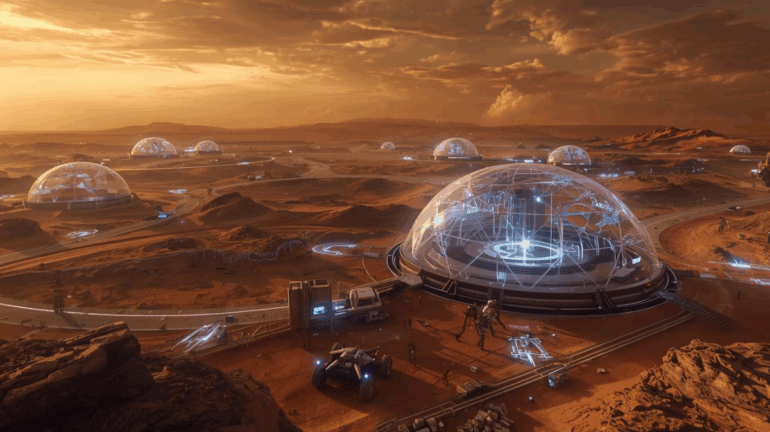

As humanity prepares to take its first steps toward becoming an interplanetary species, artificial intelligence is emerging as the most essential partner in our journey beyond Earth. Space colonization is not simply about rockets, habitats, or propulsion; it is about creating self-sustaining ecosystems in places where human life is nearly impossible. From Mars to the Moon and eventually to deep-space settlements, AI will be the invisible architect, mechanic, protector, and companion shaping the future of off-world civilization. Space presents a deadly set of challenges extreme radiation, unpredictable environments, communication delays, limited resources, and the impossibility of continuous human supervision. AI fills these gaps by enabling autonomy, precision, and resilience far beyond human capacity. Long before humans arrive on a new world, AI-powered robots will likely land first to survey terrain, scan for water, map mineral deposits, and build the initial infrastructure. Autonomous construction systems could assemble habitats, set up solar farms, mine ice for water, and manufacture fuel using in-situ resources, creating fully prepared environments for human settlers. On Mars, for instance, where communication delays can reach 22 minutes, only AI-driven systems can build and maintain structures in real time. These machines will continuously monitor pressure, oxygen levels, radiation, and soil conditions to ensure survival.
Once humans arrive, AI becomes even more indispensable. Life in space requires constant vigilance, and autonomous systems will handle everything from hydroponic farming to atmospheric control. AI-managed greenhouses can optimize plant growth by adjusting light, nutrients, and humidity, ensuring a stable food supply without human trial and error. Smart environmental systems will detect microscopic changes in habitat integrity that humans might overlook, such as hairline cracks caused by micrometeorites or fluctuations in air composition. In emergency scenarios, AI can make instant decisions to seal compartments, reroute oxygen, or guide astronauts to safety. Medicine also transforms in space colonies thanks to AI. With limited access to hospitals or specialists, AI-powered diagnostic tools, robotic surgeons, and digital health assistants become essential. They can analyze vital signs, detect anomalies, predict illnesses, and even perform minimally invasive procedures under human supervision.
AI will also enable space exploration at a scale never seen before. Autonomous rovers and drones can explore caves, lava tubes, and underground environments that humans cannot initially access. These hidden areas may offer natural protection from radiation and could become the first viable homes for settlers. On the Moon and Mars, AI-driven vehicles can transport materials, repair machinery, and build large-scale infrastructure such as roads, landing pads, and protective domes. Beyond planetary surfaces, AI will be crucial onboard spacecraft traveling vast distances. During long-duration missions to Jupiter, Saturn, or even interstellar space, AI will run navigation, propulsion adjustments, and life-support operations without constant human input. It can analyze sensor data, avoid hazards, optimize energy use, and adapt to unexpected events more efficiently than any crew.
Yet the integration of AI into space colonization goes beyond practical necessity. It raises profound questions about companionship, trust, and the role of machines in human society. In isolated environments far from Earth, AI companions whether humanoid robots or virtual agents may provide emotional support, mental health assistance, and cognitive engagement for astronauts. Loneliness and psychological stress are major concerns for long-term missions, and emotionally aware AI could help maintain stability and prevent cognitive decline.
However, reliance on AI also introduces ethical challenges. If autonomous systems make decisions for the survival of a colony, who holds authority? How do we ensure AI follows human values when isolated from Earth for years? Could a malfunction or misalignment endanger a colony? The balance between AI autonomy and human oversight will be one of the most critical issues for space governance.
Ultimately, space colonization is a collaboration between human courage and machine intelligence. AI is not just a tool it is the foundation that makes interplanetary living possible. With the help of intelligent systems, humanity may soon build thriving settlements beyond Earth, creating a new chapter in our evolution. The journey to the stars will not be taken alone; AI will be our engineer, protector, navigator, and partner as we expand life into the cosmos.
Contributed by Guestposts.Biz