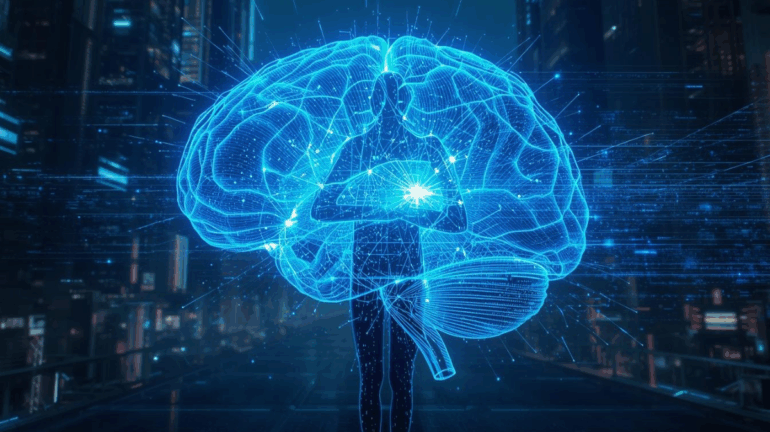

Human beings have always feared the inevitability of death, and across cultures and history, we’ve constantly searched for ways to preserve our memories, values, and identity. Today, artificial intelligence is transforming that ancient longing into a realistic possibility through the concept of digital immortality the idea that an individual’s mind, personality, and consciousness could one day continue to exist beyond the physical body. Although it remains speculative, breakthroughs in neural mapping, memory encoding, and AI-driven personality simulation are accelerating discussions about what it means to live forever in a digital form.
Digital immortality takes several potential shapes. The most familiar is the creation of AI avatars trained on a person’s messages, voice recordings, decisions, and behavioral patterns. These systems already exist in basic forms; they mimic how someone speaks or responds but lack deeper cognition. In the future, however, with advances in long-term memory modeling, emotional understanding, and neural emulation, these avatars could become more faithful digital counterparts able to continue conversations, offer advice, or interact with loved ones long after a person has passed away. For some, this promises comfort and continuity; for others, it raises the question of authenticity. Is an AI trained on a lifetime of data truly “you,” or merely a sophisticated imitation?
The more advanced vision of digital immortality involves mind uploading, where the brain’s neural patterns are mapped and transferred into an artificial substrate. This requires technology far beyond our current capabilities, including ultra-precise scanning of the human brain at the synaptic level and an AI model capable of reproducing the dynamic processes that generate identity, memory, and emotion. Neurologists remain divided: some believe the brain is an information system that can eventually be replicated; others argue that consciousness emerges from biological processes that cannot be duplicated in silicon. Even if mind uploading becomes possible, it introduces profound philosophical dilemmas. Would the uploaded mind be the same person or simply a copy? If both the physical and digital versions existed simultaneously, which is the “real” one?
Ethically, digital immortality opens a new frontier. Who owns the data that makes up a person’s mind? Could digital beings possess legal status, rights, or autonomy? Would they age, evolve, or remain static snapshots of the individuals they once were? There is also the societal impact to consider. If wealthy individuals could preserve themselves indefinitely through AI, would immortality become the ultimate inequality? Or could digital continuity contribute to a new era of shared knowledge, where the wisdom of generations is preserved and accessible forever?
Yet the pursuit of digital immortality also reflects a deeply human desire the wish to be remembered, to leave a legacy, to hold onto identity against the passage of time. AI technologies may never perfectly replicate a human soul, but they may offer new ways to preserve stories, experiences, and emotions in forms more dynamic than books, recordings, or photographs. For some, digital immortality may not be about escaping death but enhancing life: enabling individuals to mentor future generations through AI, preserving cultural memory, or contributing to humanity long after their physical presence is gone.
In the end, digital immortality forces us to examine what defines personhood. Are we our memories? Our personalities? Our consciousness? Our relationships? AI will not simply answer these questions but reshape them. As technology edges closer to copying the human mind, society must confront the ethics, emotions, and existential meaning behind living forever or being remembered forever in digital form. Whether mind uploading becomes real or remains metaphorical, the idea of digital immortality pushes us toward deeper reflection about life, legacy, and what it means to be human in an age where memory and identity can be preserved by intelligent machines.
Contributed by Guestposts.Biz