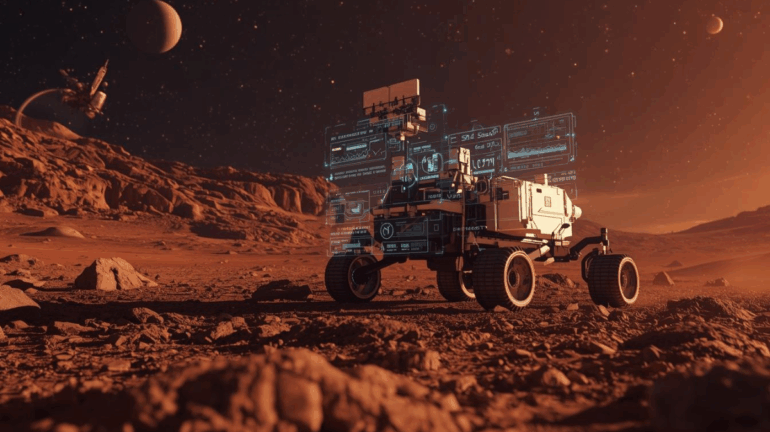

Space has always represented humanity’s ultimate frontier a realm of mystery, challenge, and limitless possibility. Today, artificial intelligence is becoming a crucial co-pilot for our journey beyond Earth, transforming how we explore, analyze, and understand the cosmos. AI is revolutionizing nearly every aspect of space exploration, from autonomous spacecraft navigation to planetary observation and even the search for extraterrestrial life. Modern spacecraft generate vast quantities of data: satellite imagery, sensor readings, spectral scans, and telemetry streams that are far too complex for humans to process in real time. Machine learning algorithms can analyze this data to detect patterns, identify anomalies, and make predictions, allowing scientists to make faster and more accurate decisions. For instance, AI helps rovers on Mars navigate treacherous terrain, detect scientifically interesting rock formations, and even select samples for analysis without waiting for instructions from Earth a delay that can take up to 20 minutes due to signal lag. In astronomy, AI is being used to sift through billions of celestial objects captured by telescopes, identifying exoplanets, classifying galaxies, and predicting cosmic events such as supernovae or asteroid trajectories.
The speed and precision of AI allow researchers to discover phenomena that might otherwise remain hidden in the noise of massive datasets. Beyond observation, AI also plays a key role in mission planning and resource optimization. Autonomous systems can plot the most efficient spacecraft routes, manage fuel consumption, and coordinate multi-satellite constellations for communication or scientific purposes. In the emerging field of space mining, AI is being used to identify valuable resources on asteroids and optimize robotic extraction, potentially reshaping Earth’s economy and energy systems. Moreover, AI is essential in life support and habitability for future crewed missions to the Moon or Mars. Intelligent systems can monitor astronaut health, optimize oxygen and energy use, and detect hazards such as radiation spikes or system failures, ensuring that human explorers remain safe in environments far beyond our atmosphere. Despite these advances, AI in space exploration is not without challenges. Space is an unforgiving environment where sensors fail, radiation interferes with electronics, and decisions must often be made autonomously without human oversight. Algorithms must be robust, adaptive, and explainable, as errors can have catastrophic consequences.
Ethical and philosophical questions also arise: how much decision-making should we delegate to AI in environments where human life hangs in the balance, and how do we ensure that exploration is guided by curiosity and ethics rather than purely commercial interests? Looking ahead, AI will likely become not just a tool but a partner in our cosmic journey. Hybrid human-AI teams may operate missions where humans provide judgment and ethical oversight while AI handles real-time data analysis and operational control. As private companies and national agencies push further into deep space, from lunar bases to Martian colonies, AI will be indispensable in navigating, surviving, and thriving in the cosmos.
In essence, artificial intelligence is not just enhancing our exploration of space; it is redefining it. With AI as our co-pilot, humanity may not only reach farther into the stars but also gain a deeper understanding of the universe, ourselves, and the delicate balance that allows life to flourish on Earth and potentially beyond. The final frontier is no longer a passive realm to observe; with AI, it becomes a dynamic space for human ingenuity, adaptability, and discovery.
Contributed by Guestposts.Biz